CY Leung to be next chief executive?
A semblance of order has returned to the chief executive selection process after Beijing's original man, Henry Tang, made himself un-selectable. Two more hopefuls almost joined the race. That would have made the circus spin out of control.
The selection criteria requires the winning candidate to secure at least 601 votes from the electoral college of 1,200. Too many contenders would have endangered that outcome.
Tsang Yok-sing, president of the Legislative Council, pulled out just before nominations closed. He was advised to do so. The DAB had 'reserved' a block of 140 votes pending his decision.
Regina Ip failed to aggregate the minimum 150 nominations from tycoons, functional constituencies and the DAB - Beijing's largest above-ground representatives in LegCo. The baggage she carries made the puppeteers nervous. No nod for her.
This was a moment of truth for the former secretary for security who fancied herself the most competent chief executive choice. The DAB has not forgiven her ingratitude after being gifted its support in the 2008 HK Island constituency election. The professional constituencies showed her the door.
Tycoons want Henry to stay. Citizens say nay
It was a disastrous few weeks for Henry Tang. Despite negative feedback from daily press, disillusioned supporters and the polls, candidate Tang carries on like nothing happened. Neither shame nor rejection has reached him.
The 18 Feb edition of The Economist has him as the "sort of amiable, vaguely trustworthy duffer..." which sums up Henry.
At the first debate held 3 March featuring the three CE hopefuls at City University before a 500-strong audience of the public and environmental activists, the post-debate votes re-confirmed Henry Tang's rejection - he got 2 percent whereas CY Leung received sixty-three percent while Albert Ho of the Democratic Party had 23 percent.
Everyone knows that the Democratic Party is unacceptable to Beijing. Albert Ho had earlier jokingly told the Financial Times of London that if he ever got selected by the 1,200 electoral college, it would be finally revealed that he is a mole of the Communist Party!
It will be a huge relief for Hong Kong to be spared being bossed by Henry Tang. China has to whisper to the selectors so he does not. It cannot risk another massive street march like the 2003 outrage which felled Tung Chee-hwa and Regina Ip for defying HK citizens in attempting to pass into legislation the Article 23 Security Bill.
It proved then that using a rubber-stamp legislature to enforce Beijing's diktat is not the way to rule. HK citizens are acutely aware of their rights and will face down any government that schemes to whittle away its existing freedoms of assembly, protest and press. So long as HK is denied universal franchise, its citizens will remain suspicious and super-vigilant.
Public unforgiving of govt-tycoon collusion
There is a sea-change in public attitudes to the privileged elites. Their ability to flout rules which ordinary citizens have to live by, is being aggressively challenged.
The widening wealth gap, unaffordable housing, lack of a safety net for the poorest and enormous budget surpluses not being used to solve systemic problems, all rankle badly. They speak of an administration badly out of touch with the people it rules.
The rough treatment incumbent chief executive Donald Tsang got in the press and in LegCo for consorting with tycoons aboard luxury yachts and private jets, and accepting a penthouse below market rent for retirement, was a signal lesson for legislators, civil servants and the next chief executive.
The simmering resentment against big business-government collusion has erupted too strongly for a return to 'business as usual'.
The 'two systems' are irreconcilable
Although Henry's extra-marital dalliances and illegal property extensions seem trivial by China benchmarks, the furious public response starkly etched the gulf separating Hong Kong and mainland attitudes to public officials and their conduct.
Leaders and party functionaries in China wield enormous clout. Citizens fear their ability to abuse power arbitrarily. Offending even a minor apparatchik can be costly to self and family. Terror rules.
Challenging injustices can be risky to life and limb as the villagers of Wukan discovered when they protested the illegal sale of their lands by party officials. Their protest committee was detained and their leader beaten to death in prison.
In Hong Kong, civil servants are expected to be polite, helpful and correct in the discharge of their duties and responsibilities. Hong Kong citizens do not fear civil or uniformed public servants. There is mutual respect. Society operates efficiently without the need to bribe or beg public officials.
HK residents are confident their courts and legal system will protect their fundamental rights. They do not expect to be kidnapped by their government in the dead of night or be beaten to sign fictitious confessions in prison. They expect their police to be law abiding and not thugs in uniform.
CY Leung right man at the right time?
Hong Kong lost 15 years through incompetent leaders appointed by Beijing. Tung Chee-hwa was a washout and Donald Tsang a nervous schoolboy waiting to be scolded on 'work-report' trips to Beijing. He will be thrashed royally this time round.
Neither had the charisma, conviction nor confidence to drive policies forward to make HK a better place for its residents. Henry Tang if selected, would stretch that to 20 years of treading water.
The scandals which crushed Tang's CE ambition and ruined Tsang's legacy, did enormous good in surfacing fundamental issues about purpose of government and public accountability of officials.
CY Leung has conducted a measured and dignified campaign so far. He has invested serious time visiting the grass-roots to appreciate the needs of the neglected sectors of HK society.
He is thoughtful, does his homework and crafts programs which he should now be articulating more forcefully. It is these very qualities which make the tycoons nervous.
CY Leung does not need to keep proving his loyalty to Beijing - a constant distraction which drained Donald Tsang. If anyone can speak for HK and be heard in Beijing, CY can.
No time to waste
Budget surpluses are there to be deployed judiciously for social good and equitable economic growth. That is a principle the property and construction tycoons vehemently oppose. They would rather pour concrete for highways, runways, railways and bridges at huge expense whether needed or not, or detrimental to environment and public health.
It is the public purse the tycoons scheme to stream for decades into their pockets with the collusion of government. It is time for Hong Kong to plot a new course. The cosy government-big business nexus has to be curbed. A fairer distribution of opportunity and access has to include a broader swathe of small entrepreneurs and medium sized businesses.
Housing affordability for the poor and the middle class has to be addressed. It is just too fundamental to be neglected any longer. What about the decade-long dodge on improving air quality and reducing traffic pollution? What about effective fair competition rules to bust cartels?
What about the wasteful Trade Development Corporation which is uneconomic and heavily subsidized, running trade exhibitions which the HK private sector is fully competent to manage without subsidies?
If CY does address these long-neglected issues in a forthright way, he can reinvigorate Hong Kong and gain the respect of its business sector and residents. He has to carry a big stick to get the civil service moving. They are masters at forming committees to 'study' issues and waste time as a tactic for inaction.
He must find a competent and respected chief secretary to replace the woefully inadequate and inarticulate Stephen Lam. CY will need an effective civil service overlord who can make things happen and is not the classic time-server and pen-pusher.
There are also too many consultants feeding at the trough. It will be useful to make all their reports open to public scrutiny. Why should consultant reports on public projects remain government secrets? How many of these consultants are proxies for big business interests? CY has to hack through all that fast.
The next chief executive has his work cut out for him. If he gets his act together fast he can re-energize Hong Kong. He may even get re-elected by a landslide through universal franchise in 2017. The one mistake he should not make is to revive the Article 23 Security Bill which HK citizens unequivocally rejected in 2003.
ENDS
Showing posts with label Regina Ip. Show all posts
Showing posts with label Regina Ip. Show all posts
Saturday, 3 March 2012


Thursday, 16 February 2012
Beijing needs to clean-up after Henry Tang's repeat indiscretions
| Goodbye Henry. My turn now. |
The media scrum was unprecedented. Cameramen perched atop six cranes hired for the purpose to beam live footage of Henry Tang's twin properties in Kowloon Tong on primetime TV newscasts.
You could have easily assumed a millionaire family was mass-murdered or a special forces raid was in progress against a terrorist bomb-making cell.
It was all far more trivial. Five buildings department inspectors were confirming the vast illegal structure constructed without planning permission under candidate Tang's twin luxury homes. He had not declared this despite an executive order to Exco members. When caught after denials and evasions, he blamed it all on his wife.
 |
| Henry's wine cellar below swimming pool Henry Tang should withdraw from the chief executive race or be ordered to do so. The bosses in Beijing know he has lost public trust. He has used his long-suffering wife twice to take the heat off him. He has no moral authority to lead Hong Kong. |
Beijing’s carefully choreographed opera for the quasi-election process has collapsed so fast and so critically close to the end-game. There is barely ten days left for the HK-Macau Affairs Office to quick-fix this crisis. The puppeteer has to pull the strings for the DAB, the HK Federation of Trade Unions and other allies to cast their nominations and votes to a revised script. But for which candidate?
The business lobby within the 1,200 electoral college is stymied. Tycoons do not want CY Leung but voting for the third candidate Albert Ho of the Democratic Party is a waste as Beijing won’t even allow leading Democrats travel access into the mainland!
Beijing’s mantra of “preserving the stability and prosperity of Hong Kong” - which they adopted as the narrative from the British administration, is lacking a stage prop. The CE quasi-election is in real danger of degenerating into pure farce.
Regina Ip’s golden moment? Regina Ip, infamous for trying to ram through the flawed Article 23 Security Bill in 2003, as secretary for security, now leads the New People’s Party. She was elected to the Legislative Council in 2008. She declared her interest to run for chief executive before but withdrew when she could not secure the minimal 150 nominations.
Regina hopes the business lobby may swing behind her as the de-facto alternative to CY Leung. Despite a supportive response from her party caucus last night, she is still dithering, unsure if at this late stage she can secure 150 nominations or have time to pitch for votes from the Election Committee. She will need momentum which only a nod from Beijing can energize. She is viewed a ‘neutral’ candidate not beholden either to the business lobby or the leftists. She is well regarded by civil servants who fear the whip of CY Leung.
Regina Ip at the start of the CE race described both Henry Tang and CY Leung as lacking the necessary "leadership qualities, competence and stamina" for the top job. She had received feelers from both camps for the position of chief secretary in the civil service. She declared she would not serve in an administration of either candidate.
Why not CY Leung?
The government’s leak of the 10-year old conflict of interest issue on the West Kowloon Arts Centre design selection apart, CY Leung has conducted a dignified campaign on his own. No one in the HK administration has explained why it was necessary to exhume this 10-year old case at this time. It could have just ignored the East Week report instead of responding to it in the middle of the CE race.
CY is neither a stooge of the business lobby nor leftwing ideologues, although his strident anti-British sentiment is well known. Beijing has long identified him as a patriot in HK. He was given very senior responsibility in drafting the Basic Law and as convenor of the post-1997 Exco since.
He knows how the HK government operates and why it has been dysfunctional the last 14 years. He understands the festering issues left unresolved and sympathizes with the bottom rung of society. He knows the tricks of the property lobby only too well and they fear him for that. He has been consistently preferred by a wide margin on all the public polls.
Perhaps it is in CY’s consistently independent streak that Beijing has misgivings. The minders at the HK-Macau Affairs Office and the Central Government Liaison Office are relaxed about the vacuity of candidate Tang. He just coasts along and is happy to follow any path shown. Candidate CY Leung has a mind of his own. He thinks. Such men are dangerous?
ENDS
Tuesday, 20 December 2011
Article 23 Security Bill slithers below the pretend CE election
 |
| Tycoons' favourite vs Public's choice |
Henry Tang has the property tycoons raising toasts to his imminent coronation. CY Leung seems to be blocked out by the moneyed elite. Henry invested in PR minders who conjured the non-slogan “We are Tomorrow” not because he was in danger of being rejected but to gain traction on public polls where C Y Leung is enjoying a massive lead.
There is greater public support for the candidate the tycoons do not like. The pretend election is already a farce even before it starts. Beijing has so far not overtly declared its preference. It initially found the idea of a competitive ‘election’ of two approved candidates a good diversion from an otherwise even sillier exercise.
Tang’s PR advisors have scheduled a series of photo-ops with actors, chambers of commerce, his alma mater and other friendlies to get him onto the front pages of press and TV news broadcasts. C Y has been doing the rounds of ‘ordinary’ people.
No clear platform from either candidate
Neither candidate is able to articulate a coherent agenda as CE when “elected” by a college of 1,200 functional constituency representatives and pro-Beijing compatriots. That is no surprise as they don’t answer to the people they are supposed to rule. Their agenda will come in a sealed brown envelope from Beijing.
Both candidates reported to the Beijing Liaison Office in the middle of their ‘campaigns’. This was monitored by HK press and widely reported. Tang said he would go if invited and did - a day after he said there was no reason for him to visit the Liaison Office. C Y said it was quite routine and that he had been there many times over the years.
Headmaster sits at Beijing Liaison Office
If HK residents needed any reminder of where power really resides in the SAR, that was it: both CE aspirants seeking approval, providing clarifications and receiving instructions from the Beijing Liaison Office. The headmaster sits there, not in Government House.
The views of 7 million Hong Kong citizens are irrelevant to this closed door, small circle exercise in annointing Beijing’s appointee.
As Beijing has delayed selection of the CE by universal suffrage till 2017, it is watching the process of the people’s will being expressed in opinion polls with some curiosity, alarm and bewilderment. It is said that Communist regimes would rather not rig elections but prefer to ensure their outcomes in advance. Russia was caught with Putin’s ‘United Russia’ ruling party agents rifling the ballot box recently. The mistake lay in getting caught.
Vote-rigging at recent District Board elections
In the District Board elections of November, there were numerous cases of vote-rigging and voter identity falsification, hinting at well organized fraud. There is suspicion that the opaque “underground fronts” may have contributed expertise. Discovery of this activity has made the agents and their sponsors uncomfortable as the HK judicial system has the power to put these criminals in the dock with potentially damaging public disclosures.
The HK administration is leaning backwards. HK press is watching the investigative process unfold with keen interest. The Democratic Party says it has received 800 reports of suspicious voter registration. The Independent Commission Against Corruption has arrested 22 people for corrupt conduct and charged six so far.
HK residents are generally sanguine about matters which are the purview of the civil service, the police and the courts. They trust their institutions of governance. They do not expect to be cheated and lied to. If their trust is betrayed, they can turn surprisingly hostile, as Tung Chee-hwa, the first CE and Regina Ip, then Secretary for Security, discovered when they tried to ram the flawed Article 23 Security Bill into law in 2003.
Time for mandatory voter registration
Because of this relaxed trust in the institutions of government, HK residents do not compulsively register to vote or exercise their right to vote. Societies of free speech, free press and respect for human rights are very fertile grounds for a committed band of organizers to take control by sheer default.
When well funded and driven by dedicated organizers sent from the mainland for ‘united front’ work (as it is euphemistically called) HK faces the prospect of its schools, volunteer groups, youth organizations, charity societies, university bodies, worker unions, District Boards and Legislative Council being taken over by elected, hardworking cadres.
It will be in the interest of the Hong Kong SAR to introduce legislation to make it mandatory for all eligible residents to register and vote in local elections so the community is not politically hijacked by default. This should become a primary objective of the next administration as HK moves to elect its 2017 CE by universal suffrage.
Along with that, legislation should also be introduced for political parties to declare their sources of funding. It will be of interest to know how much money is being channelled to which political party and proxies from which sponsor. It is up to HK citizens to then decide who to vote for.
Under normal circumstances this would be relevant and vital information. However there is considerable fear that retribution will be visited on businessmen and other donors to Democratic parties, so the administration would rather close an eye on the subject.
Jimmy Lai’s donations to the Democratic & Civic Parties over the years raised considerable noise from the compatriots. The sponsorship from across the border to pro-Beijing parties and front organizations passes without comment.
Whither Article 23 Security Bill?
Buried in all the pseudo-election distraction is the ominous Article 23 Security Bill. If the SAR Legislature does not pass this into law within the life of the 2012 administration, it will be near impossible to pull the trick after 2017.
Whither Article 23 Security Bill?
Buried in all the pseudo-election distraction is the ominous Article 23 Security Bill. If the SAR Legislature does not pass this into law within the life of the 2012 administration, it will be near impossible to pull the trick after 2017.
There is no public discussion about it. There are fitful rumours about its revival and sundry ‘patriots’ lament its absence. The Macau SAR passed its Security Bill without fuss in 2009. There is agitation on the streets of Macau now for greater democracy - perhaps too late.
Neither Henry Tang nor C Y Leung has declared a clear position on it. When asked, they waffle. Given the unequivocal Hong Kong rejection (in 2003) of an alignment to mainland style criminalization of freedoms of assembly, expression, press and guaranteed human rights, no candidate for CE in 2017 would be elected if his platform compromised the freedoms and rights HK people take for granted.
Chessboard re-arranged. Stephen Lam promoted to Queen
It is not mere coincidence that Secretary for Constitutional & Mainland Affairs, Stephen Lam Sui-lung, was selected ahead of more suitable policy secretaries, to replace Henry Tang as Chief Secretary to the HKSAR Government. He is a critical piece on the chessboard.
In defending Lam’s appointment as Chief Secretary with the lowest public approval rating of any since 1997, Donald Tsang suggested that Lam’s love of Hong Kong is beyond question even if Hong Kong citizens rate him low. Stephen Lam is surprisingly elevated to the most powerful position in HK’s civil service and nobody has explained why. It is a strategically calibrated move.
Lam distinguished himself in his previous position for attempting - without public consultation - to push a rule that a Legislative Council (LegCo) seat falling vacant due to resignation or death of a sitting member will be immediately replaced, without a by-election, by the candidate who secured the next highest number of votes in the last election!
This situation was forced by the Democrats resigning their seats to protest the continued stalling by the administration for full direct elections by 2012. About half the current LegCo seats are held by nominated ‘Functional Constituency’ representatives from corporate and other entities, many regarded ‘rotten boroughs’ created to stack the pro-Beijing deck.
It is not fanciful to expect the 2012 CE to be tasked with passing the Article 23 into law. Stephen Lam will have a key role there. He will be the lightning rod to draw and earth the disgust of citizens.
The planned next phase of Article 23 is the clear and present danger to Hong Kong.
ENDS
Neither Henry Tang nor C Y Leung has declared a clear position on it. When asked, they waffle. Given the unequivocal Hong Kong rejection (in 2003) of an alignment to mainland style criminalization of freedoms of assembly, expression, press and guaranteed human rights, no candidate for CE in 2017 would be elected if his platform compromised the freedoms and rights HK people take for granted.
Chessboard re-arranged. Stephen Lam promoted to Queen
It is not mere coincidence that Secretary for Constitutional & Mainland Affairs, Stephen Lam Sui-lung, was selected ahead of more suitable policy secretaries, to replace Henry Tang as Chief Secretary to the HKSAR Government. He is a critical piece on the chessboard.
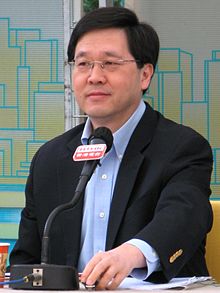 |
| Lam, the most unpopular Chief Secretary since 1997 |
In defending Lam’s appointment as Chief Secretary with the lowest public approval rating of any since 1997, Donald Tsang suggested that Lam’s love of Hong Kong is beyond question even if Hong Kong citizens rate him low. Stephen Lam is surprisingly elevated to the most powerful position in HK’s civil service and nobody has explained why. It is a strategically calibrated move.
Lam distinguished himself in his previous position for attempting - without public consultation - to push a rule that a Legislative Council (LegCo) seat falling vacant due to resignation or death of a sitting member will be immediately replaced, without a by-election, by the candidate who secured the next highest number of votes in the last election!
This situation was forced by the Democrats resigning their seats to protest the continued stalling by the administration for full direct elections by 2012. About half the current LegCo seats are held by nominated ‘Functional Constituency’ representatives from corporate and other entities, many regarded ‘rotten boroughs’ created to stack the pro-Beijing deck.
It is not fanciful to expect the 2012 CE to be tasked with passing the Article 23 into law. Stephen Lam will have a key role there. He will be the lightning rod to draw and earth the disgust of citizens.
The planned next phase of Article 23 is the clear and present danger to Hong Kong.
ENDS
Sunday, 20 November 2011
Is Henry Tang, CY Leung or Regina Ip right for CE leadership of Hong Kong?
Two HK Executive Council seniors, Henry Tang and C Y Leung resigned their posts to flag their 'intention to stand' for Chief Executive of the HK Special Administrative Region.
 |
| Henry drove no memorable policy initiatives in 10 years |
 |
| CY Leung is a better bet |
 |
| Regina re-inventing herself after Article 23 fiasco |
None of the three have formally filed their papers for the Chief Executive post yet. Their candidacy for election depends on securing a minimal threshold of support from an Electoral College of 1,200 whose identity will only be known in December.
Beijing has not given the nod to any of the hopefuls so far. That has made the public posturing a circus of confused horses. The ring master is missing. Why? Perhaps the odd circumstances of the three contenders may give a clue:
Tang's wife forgives. No comment on illegitimate child
in 2012
Given Hong Kong's nosy and intrusive press, insinuations of Henry's affair with a senior aide and other ladies surfaced. There were rumours of a child out of wedlock. Henry was advised by his PR minders to call a press conference with his wife by his side. The dutiful wife smiled bravely. Henry was contrite.
Millionaires in Hong Kong have never been starved of female company. Nobody else bothers. The PR exercise came across as unnecessary, trivial and distracting. The important question is whether Henry is the right person for the CE job?
The attempt at public confession has only put Henry under a stubborn cloud of doubt as he dodges reporters' questions of a child by the other woman. Does this say anything about Henry Tang's suitability for Chief Executive? Is it relevant at all?
Henry has distinguished himself in ten years of public service by being remembered for nothing of any significance apart from removing the tax on wine. In one sense that gives comfort to Beijing. He will not initiate or champion matters of public policy on his own. He will do as he is told.
Despite that Beijing may yet look beyond Henry Tang - if only to have a squeaky-clean CE untainted by extra-marital affairs and hounded by a paparazzi press which refuses to let go.
Given a choice, the property tycoons whom Beijing defers to, would like Tang to be the next CE. No less than 'superman' Li Ka-shing has already endorsed Henry publicly.
CY Leung's shares shrink 90% in DTZ
CY Leung faces a paper loss of near HK$300 million on his shares in listed DTZ Holdings Plc. He injected his real estate consultancy CY Leung & Co into the larger London listed DTZ in 1999, following that with more investment in DTZ stock in 2006 and 2009, to become one of its four largest shareholders - which got him a seat on the parent board and chairmanship of DTZ Asia-Pacific.
His shareholding was worth HK$290 million in 2007. DTZ shares from their peak in 2006 of 835 pence per share have plunged to 3 pence recently. Its latest financial position shows liabilities of HK$783 million with an alarming HK$1.1 billion in negative tangible asset value and outstanding short and long-term bank debt of more than HK$1.3 billion. DTZ's weighting in USA real estate and aggressive debt-financed acquisitions of European companies has left it badly exposed in the global downturn.
In a city which prides itself on tycoons who ride business cycles with sang-froid, this misadventure comes at the worst possible time for CY Leung. When asked about the DTZ, Leung repeated the investment caveat to reporters that shares go up and come down. He assured them he is not in financial trouble.
Hong Kong is looking for confident leadership to steer it through looming global recession and policy muddles in public housing, education, inflation, unemployment and a de-stabilizing wealth gap.
Is he a safe pair of hands? This twist of the DTZ may lose CY Leung points with both Beijing and the property tycoons stuffed into the Election Committee.
Regina Ip waits to be rewarded for loyalty
No one can doubt Regina Ip's doughty loyalty as Secretary for Security under Tung Chee-hwa, Hong Kong's first CE. She threatened, brow-beat and derided anyone who dared point out the many flaws of the hastily drafted Article 23 Security Bill.
She tried to bulldoze the Article 23 Bill through LegCo despite representations from civic society, professional bodies, media associations, journalists, lawyers and chambers of commerce.
 |
| Popular with cartoonists |
Hong Kong's normally staid citizenry poured out of their homes on a hot July afternoon in 2003 to flood the streets from Victoria Park to the Government Offices in Central for six hours of massive, peaceful and orderly protest against the threat to their freedoms of press, assembly and right to protest.
 |
| HK citizens were not amused |
Since that singular lesson not to underestimate the resolve of Hong Kong residents, Beijing has been careful to gauge the public mood. It has opted for a softer touch rather than ramming through ideological agendas. That may explain the current 'wait-and-see' on the CE candidates.
Beijing continues its steady, low-key placement of loyalists in the civil service and academic institutions. 'Golden Bauhinia' medals (for distinguished public service) are pinned annually on obscure folk from previously 'underground fronts' whom most Hong Kong residents have never heard of, which attracts as much derision locally as the Confucian Prize introduced to rival the Nobel Prize.
Regina Ip is reinventing herself as a people's champion. She chairs the Savantas Institute which studies policy issues on democratic development and heads the New People's Party which garnered 4 seats in the recent District Council elections where the Democratic camp suffered a drubbing.
She stoked the anxiety of HK residents about a flood of immigrants leaving low-paid (below HK's own minimum wage) maid's jobs to compete with locals for regular employment - after a 25-year term domestic worker sought a Court ruling on right of abode.
Regina has recently given condescending advice to the Democratic camp not to stand up for moral causes like right of abode for maids and anti-racist legislation.
Regina Ip's opportunistic talent was in full display when she took off like a jack rabbit to lobby the National People's Congress in Beijing to deny right of abode to domestic helpers - even before HK Courts could hear the test case.
As a former Principal Official of the HK Government and current legislator, she is pledged to uphold the rule of law and Hong Kong's unique Special Administrative Region status. She undermines both in her unseemly haste to parade her 'loyalty' to Beijing. She waits to be rewarded.
There have been trial balloons floated by Beijing compatriots in Hong Kong for the re-introduction of the reviled Article 23 Security Bill. That may well be a hidden condition of the appointment of the next CE. Regina Ip is eminently qualified for a repeat performance, if called upon. Beijing should be wary.
Most important job not for the most competent
The lack of universal suffrage in choosing a leader on merit, leaves the SAR poorly prepared to face the economic tsunami ahead. In boom times that may not matter but Hong Kong has already lost 14 years through limp leadership on fundamental issues. It cannot waste another five years.
Of the three hopefuls, CY Leung seems at least to have considered views on overdue policy matters. He is known to be action-oriented. The worst possible outcome in the current scenario, is for Regina Ip to slide in by default.
ENDS
Subscribe to:
Posts (Atom)