CY Leung to be next chief executive?
A semblance of order has returned to the chief executive selection process after Beijing's original man, Henry Tang, made himself un-selectable. Two more hopefuls almost joined the race. That would have made the circus spin out of control.
The selection criteria requires the winning candidate to secure at least 601 votes from the electoral college of 1,200. Too many contenders would have endangered that outcome.
Tsang Yok-sing, president of the Legislative Council, pulled out just before nominations closed. He was advised to do so. The DAB had 'reserved' a block of 140 votes pending his decision.
Regina Ip failed to aggregate the minimum 150 nominations from tycoons, functional constituencies and the DAB - Beijing's largest above-ground representatives in LegCo. The baggage she carries made the puppeteers nervous. No nod for her.
This was a moment of truth for the former secretary for security who fancied herself the most competent chief executive choice. The DAB has not forgiven her ingratitude after being gifted its support in the 2008 HK Island constituency election. The professional constituencies showed her the door.
Tycoons want Henry to stay. Citizens say nay
It was a disastrous few weeks for Henry Tang. Despite negative feedback from daily press, disillusioned supporters and the polls, candidate Tang carries on like nothing happened. Neither shame nor rejection has reached him.
The 18 Feb edition of The Economist has him as the "sort of amiable, vaguely trustworthy duffer..." which sums up Henry.
At the first debate held 3 March featuring the three CE hopefuls at City University before a 500-strong audience of the public and environmental activists, the post-debate votes re-confirmed Henry Tang's rejection - he got 2 percent whereas CY Leung received sixty-three percent while Albert Ho of the Democratic Party had 23 percent.
Everyone knows that the Democratic Party is unacceptable to Beijing. Albert Ho had earlier jokingly told the Financial Times of London that if he ever got selected by the 1,200 electoral college, it would be finally revealed that he is a mole of the Communist Party!
It will be a huge relief for Hong Kong to be spared being bossed by Henry Tang. China has to whisper to the selectors so he does not. It cannot risk another massive street march like the 2003 outrage which felled Tung Chee-hwa and Regina Ip for defying HK citizens in attempting to pass into legislation the Article 23 Security Bill.
It proved then that using a rubber-stamp legislature to enforce Beijing's diktat is not the way to rule. HK citizens are acutely aware of their rights and will face down any government that schemes to whittle away its existing freedoms of assembly, protest and press. So long as HK is denied universal franchise, its citizens will remain suspicious and super-vigilant.
Public unforgiving of govt-tycoon collusion
There is a sea-change in public attitudes to the privileged elites. Their ability to flout rules which ordinary citizens have to live by, is being aggressively challenged.
The widening wealth gap, unaffordable housing, lack of a safety net for the poorest and enormous budget surpluses not being used to solve systemic problems, all rankle badly. They speak of an administration badly out of touch with the people it rules.
The rough treatment incumbent chief executive Donald Tsang got in the press and in LegCo for consorting with tycoons aboard luxury yachts and private jets, and accepting a penthouse below market rent for retirement, was a signal lesson for legislators, civil servants and the next chief executive.
The simmering resentment against big business-government collusion has erupted too strongly for a return to 'business as usual'.
The 'two systems' are irreconcilable
Although Henry's extra-marital dalliances and illegal property extensions seem trivial by China benchmarks, the furious public response starkly etched the gulf separating Hong Kong and mainland attitudes to public officials and their conduct.
Leaders and party functionaries in China wield enormous clout. Citizens fear their ability to abuse power arbitrarily. Offending even a minor apparatchik can be costly to self and family. Terror rules.
Challenging injustices can be risky to life and limb as the villagers of Wukan discovered when they protested the illegal sale of their lands by party officials. Their protest committee was detained and their leader beaten to death in prison.
In Hong Kong, civil servants are expected to be polite, helpful and correct in the discharge of their duties and responsibilities. Hong Kong citizens do not fear civil or uniformed public servants. There is mutual respect. Society operates efficiently without the need to bribe or beg public officials.
HK residents are confident their courts and legal system will protect their fundamental rights. They do not expect to be kidnapped by their government in the dead of night or be beaten to sign fictitious confessions in prison. They expect their police to be law abiding and not thugs in uniform.
CY Leung right man at the right time?
Hong Kong lost 15 years through incompetent leaders appointed by Beijing. Tung Chee-hwa was a washout and Donald Tsang a nervous schoolboy waiting to be scolded on 'work-report' trips to Beijing. He will be thrashed royally this time round.
Neither had the charisma, conviction nor confidence to drive policies forward to make HK a better place for its residents. Henry Tang if selected, would stretch that to 20 years of treading water.
The scandals which crushed Tang's CE ambition and ruined Tsang's legacy, did enormous good in surfacing fundamental issues about purpose of government and public accountability of officials.
CY Leung has conducted a measured and dignified campaign so far. He has invested serious time visiting the grass-roots to appreciate the needs of the neglected sectors of HK society.
He is thoughtful, does his homework and crafts programs which he should now be articulating more forcefully. It is these very qualities which make the tycoons nervous.
CY Leung does not need to keep proving his loyalty to Beijing - a constant distraction which drained Donald Tsang. If anyone can speak for HK and be heard in Beijing, CY can.
No time to waste
Budget surpluses are there to be deployed judiciously for social good and equitable economic growth. That is a principle the property and construction tycoons vehemently oppose. They would rather pour concrete for highways, runways, railways and bridges at huge expense whether needed or not, or detrimental to environment and public health.
It is the public purse the tycoons scheme to stream for decades into their pockets with the collusion of government. It is time for Hong Kong to plot a new course. The cosy government-big business nexus has to be curbed. A fairer distribution of opportunity and access has to include a broader swathe of small entrepreneurs and medium sized businesses.
Housing affordability for the poor and the middle class has to be addressed. It is just too fundamental to be neglected any longer. What about the decade-long dodge on improving air quality and reducing traffic pollution? What about effective fair competition rules to bust cartels?
What about the wasteful Trade Development Corporation which is uneconomic and heavily subsidized, running trade exhibitions which the HK private sector is fully competent to manage without subsidies?
If CY does address these long-neglected issues in a forthright way, he can reinvigorate Hong Kong and gain the respect of its business sector and residents. He has to carry a big stick to get the civil service moving. They are masters at forming committees to 'study' issues and waste time as a tactic for inaction.
He must find a competent and respected chief secretary to replace the woefully inadequate and inarticulate Stephen Lam. CY will need an effective civil service overlord who can make things happen and is not the classic time-server and pen-pusher.
There are also too many consultants feeding at the trough. It will be useful to make all their reports open to public scrutiny. Why should consultant reports on public projects remain government secrets? How many of these consultants are proxies for big business interests? CY has to hack through all that fast.
The next chief executive has his work cut out for him. If he gets his act together fast he can re-energize Hong Kong. He may even get re-elected by a landslide through universal franchise in 2017. The one mistake he should not make is to revive the Article 23 Security Bill which HK citizens unequivocally rejected in 2003.
ENDS
Saturday, 3 March 2012


Friday, 2 March 2012
Zero-tolerance for Jerk bosses?
Hack away bad managers or hire good ones first?
Any system which tolerates and sustains toxic managers is already dysfunctional. Any CEO (assuming he is not a jerk himself) wishing to re-align company culture must weed out toxic bosses as priority. That immediately signals detoxification of power as corporate policy to abusers and their hapless victims.
It warns power-poisoned managers that respect for human beings is a core-value of the organization that will not be transgressed. Such diseased bosses at all levels will be axed as top priority. Their abused staff will out them and the CEO will axe them.
Systematic removal of abusers of power will generate huge relief within the company, retain good employees and attract top talent from other organizations where such abuse is tolerated.
Fix the problem or forever lose good people
When competent staff at all all levels routinely leave an organization and the ones left behind with tenure are mediocre, it can be traced to a culture of abuse emanating from the top.
One can always pay over market rates to attract top talent. It is impossible to retain them if the power-abuse culture continues.
So if an organization wants an industry reputation for being an attractive place for high performers, it must shred its power-abusers first as a matter of policy.
Why axe jerks in management fast?
Staff will be able to re-focus on the real objectives of the organization rather than slavishly kiss-up to survive. They would not be distracted by whims, moods and arbitrary decisions of power-diseased managers.
Managers are an expensive resource. Because they are given power over people within hierarchies, their impact, for good or bad, is magnified. Power bestowed and not earned, can be taken away. An effective people-manager dervives his power from his team.
A manager with his head screwed on right and focused on end-results by coaching, leading and mentoring, will multiply positive energy. Apart from guiding his group, he would also defend them from jerk managers around or above them when necessary.
Conversely, a jerk manager will be wasting his and his subordinates' time in power-diseased behaviour. The collective mind of the disoriented group will not be on meeting meaningful objectives but on basic survival from abuse.
What about competent specialists behaving badly?
There are situations of particular expertise which is rare and vital. If such an expert is also a source of negativity to people around and below him in the organization, two avenues have to be pursued in tandem - search for a replacement and re-define his role to one of solo problem-solver.
The jerk has to be isolated from poisoning the many. A competent replacement has to be found in due time so that the offender can be donated to a rival company. He has to be jettisoned at some point. The sooner the better.
No company has the right to knowingly damage the psychological health of its staff by allowing power-diseased managers to continue.
360 feedback to check power abuse
Many organizations are dogmatic about their annual ritual of performance evaluation, yet shrink from implementing a 360 feedback review process in parallel!
That is the surest clue to a culture of abuse enshrined in a hierarchy of abusers at the top dishing it out to levels below.
As with all the studies of abuse in families, prisons, churches, cults and the military, it is the abused who become abusers in turn.
Until this cycle of toxic power-abuse is broken, it will not be possible to shape a healthy way to optimize performance in organizations.
ENDS
Any system which tolerates and sustains toxic managers is already dysfunctional. Any CEO (assuming he is not a jerk himself) wishing to re-align company culture must weed out toxic bosses as priority. That immediately signals detoxification of power as corporate policy to abusers and their hapless victims.
It warns power-poisoned managers that respect for human beings is a core-value of the organization that will not be transgressed. Such diseased bosses at all levels will be axed as top priority. Their abused staff will out them and the CEO will axe them.
Systematic removal of abusers of power will generate huge relief within the company, retain good employees and attract top talent from other organizations where such abuse is tolerated.
Fix the problem or forever lose good people
When competent staff at all all levels routinely leave an organization and the ones left behind with tenure are mediocre, it can be traced to a culture of abuse emanating from the top.
One can always pay over market rates to attract top talent. It is impossible to retain them if the power-abuse culture continues.
So if an organization wants an industry reputation for being an attractive place for high performers, it must shred its power-abusers first as a matter of policy.
Why axe jerks in management fast?
Staff will be able to re-focus on the real objectives of the organization rather than slavishly kiss-up to survive. They would not be distracted by whims, moods and arbitrary decisions of power-diseased managers.
Managers are an expensive resource. Because they are given power over people within hierarchies, their impact, for good or bad, is magnified. Power bestowed and not earned, can be taken away. An effective people-manager dervives his power from his team.
A manager with his head screwed on right and focused on end-results by coaching, leading and mentoring, will multiply positive energy. Apart from guiding his group, he would also defend them from jerk managers around or above them when necessary.
Conversely, a jerk manager will be wasting his and his subordinates' time in power-diseased behaviour. The collective mind of the disoriented group will not be on meeting meaningful objectives but on basic survival from abuse.
What about competent specialists behaving badly?
There are situations of particular expertise which is rare and vital. If such an expert is also a source of negativity to people around and below him in the organization, two avenues have to be pursued in tandem - search for a replacement and re-define his role to one of solo problem-solver.
The jerk has to be isolated from poisoning the many. A competent replacement has to be found in due time so that the offender can be donated to a rival company. He has to be jettisoned at some point. The sooner the better.
No company has the right to knowingly damage the psychological health of its staff by allowing power-diseased managers to continue.
360 feedback to check power abuse
Many organizations are dogmatic about their annual ritual of performance evaluation, yet shrink from implementing a 360 feedback review process in parallel!
That is the surest clue to a culture of abuse enshrined in a hierarchy of abusers at the top dishing it out to levels below.
As with all the studies of abuse in families, prisons, churches, cults and the military, it is the abused who become abusers in turn.
Until this cycle of toxic power-abuse is broken, it will not be possible to shape a healthy way to optimize performance in organizations.
ENDS
Thursday, 23 February 2012
Hong Kong's freewheeling press spoils chief executive circus
Where did CE wagon go off the rails?
Only four months ago it looked a neat circus act. Two dancing bears, Henry and CY enter the ring and begin their routines. They check regularly with the ring master for approval. A third untrained bear, Ho, securely chained, is allowed in to add drama. The audience knows the story. The act is predictable but vaguely entertaining like familiar Cantonese opera. The hero known by all beforehand, will emerge victorious from the noise and distraction.
But for the raucous, unruly press of Hong Kong, the circus would have played to script. It was not to be. The editors took a keen interest in the candidates who wished to rule HK. They searched their past and their present for clues to who they really are, what drives them to seek such power, who is behind them and why.
Tang plays more than women and wine cellars
The Ming Pao newspaper first disclosed the illegal construction beneath candidate Tang’s twin mansions in Kowloon Tong. Tang was the administration’s second most senior officer when the government initiated a long-overdue clampdown on unauthorised structures to property. Chief executive Donald Tsang asked his team to make sure they were clean on this. Henry decided not to reveal his underground secret.
It now appears Tang could have submitted false building plans for approval, omitting the grand basement complex below his swimming pool. He would have required an architect to sign off on the planning submissions. There is a trail of professional breach of code and trust. It was fraud.
His pattern of response to misdemeanours has been to deny wrongdoing, then fudge the issue and when caught, find a scapegoat. Then become contrite, ask for a second chance and promise good behaviour. But vote for him please.
Even more serious than his extra-marital affairs and illegal construction work, was his clumsy attempt to pin the 2003 Harbour Fest fiasco on civil servant Mike Rowse. That backfired when Rowse sought a judicial review which found for him in 2008. Tang had asked for minutes of meetings to be deleted which were material to any inquiry. The government’s internal inquiry in 2004 pinned blame on Rowse and docked a month’s salary following its disciplinary process.
Tang chaired the Economic Relaunch Strategy Group set up to revive the economy after the SARS scare in 2003. The HK Government had underwritten up to HK$100million of the Harbour Fest program whose main organizer was the American Chamber of Commerce. That had to be paid out in full when the event overran its HK$1 billion budget by HK$13.3 million.
The “Accountability System” which Tung Chee-hwa the first CE put into place to justify political appointments, was nowhere to be seen as Tang and his boss Tsang evaded responsibility.
Chief executive on junkets with oligarchs
The Sun, a free tabloid of the Oriental Daily Group caught current chief executive Donald Tsang wining, dining and luxury yachting with tycoons and mobster bosses in Macau over the weekend. That forced Tsang to stage a homely interview with RTHK for primetime news channels, portraying himself as a humble civil servant on a much needed break with friends. He denied being a luxury private plane and yacht beneficiary, enjoying the high life with tycoons and gambling godfathers, as the territory’s press would have him.
The South China Morning Post front paged drawings of the three floors of Donald’s luxury complex in Shenzen across the border where he says he will retire when his term ends in June. A local architect who commented on the plans in the report, observed that a 300sf garden seems to have been added after the building plans were approved by the authorities - which in HK would be regarded an illegal structure.
Independent press a nuisance
Both Tang and Tsang would have dearly loved a situation where media know their place and are afraid of political strongmen. Where editors would self-censor or can be fired. Where publishers can be instructed to suppress information. Where newspapers can be licensed and their right to publish cancelled on edict.
There is little else to check the abuse of the oligarchs, their collaborators in government and ideologues eager to turn the territory into a police state.
Hong Kong needs to be wary of the next chief executive resurrecting the discarded Article 23 Security legislation which seeks to curb the freedoms of press, assembly, protest and distribution of information. And of legislators who will rubber stamp it.
Once such a dangerous law is allowed onto the Statutes, it will be near impossible to get rid of it.
ENDS
Only four months ago it looked a neat circus act. Two dancing bears, Henry and CY enter the ring and begin their routines. They check regularly with the ring master for approval. A third untrained bear, Ho, securely chained, is allowed in to add drama. The audience knows the story. The act is predictable but vaguely entertaining like familiar Cantonese opera. The hero known by all beforehand, will emerge victorious from the noise and distraction.
But for the raucous, unruly press of Hong Kong, the circus would have played to script. It was not to be. The editors took a keen interest in the candidates who wished to rule HK. They searched their past and their present for clues to who they really are, what drives them to seek such power, who is behind them and why.
Tang plays more than women and wine cellars
The Ming Pao newspaper first disclosed the illegal construction beneath candidate Tang’s twin mansions in Kowloon Tong. Tang was the administration’s second most senior officer when the government initiated a long-overdue clampdown on unauthorised structures to property. Chief executive Donald Tsang asked his team to make sure they were clean on this. Henry decided not to reveal his underground secret.
It now appears Tang could have submitted false building plans for approval, omitting the grand basement complex below his swimming pool. He would have required an architect to sign off on the planning submissions. There is a trail of professional breach of code and trust. It was fraud.
His pattern of response to misdemeanours has been to deny wrongdoing, then fudge the issue and when caught, find a scapegoat. Then become contrite, ask for a second chance and promise good behaviour. But vote for him please.
Even more serious than his extra-marital affairs and illegal construction work, was his clumsy attempt to pin the 2003 Harbour Fest fiasco on civil servant Mike Rowse. That backfired when Rowse sought a judicial review which found for him in 2008. Tang had asked for minutes of meetings to be deleted which were material to any inquiry. The government’s internal inquiry in 2004 pinned blame on Rowse and docked a month’s salary following its disciplinary process.
Tang chaired the Economic Relaunch Strategy Group set up to revive the economy after the SARS scare in 2003. The HK Government had underwritten up to HK$100million of the Harbour Fest program whose main organizer was the American Chamber of Commerce. That had to be paid out in full when the event overran its HK$1 billion budget by HK$13.3 million.
The “Accountability System” which Tung Chee-hwa the first CE put into place to justify political appointments, was nowhere to be seen as Tang and his boss Tsang evaded responsibility.
Chief executive on junkets with oligarchs
The Sun, a free tabloid of the Oriental Daily Group caught current chief executive Donald Tsang wining, dining and luxury yachting with tycoons and mobster bosses in Macau over the weekend. That forced Tsang to stage a homely interview with RTHK for primetime news channels, portraying himself as a humble civil servant on a much needed break with friends. He denied being a luxury private plane and yacht beneficiary, enjoying the high life with tycoons and gambling godfathers, as the territory’s press would have him.
The South China Morning Post front paged drawings of the three floors of Donald’s luxury complex in Shenzen across the border where he says he will retire when his term ends in June. A local architect who commented on the plans in the report, observed that a 300sf garden seems to have been added after the building plans were approved by the authorities - which in HK would be regarded an illegal structure.
Independent press a nuisance
Both Tang and Tsang would have dearly loved a situation where media know their place and are afraid of political strongmen. Where editors would self-censor or can be fired. Where publishers can be instructed to suppress information. Where newspapers can be licensed and their right to publish cancelled on edict.
There is little else to check the abuse of the oligarchs, their collaborators in government and ideologues eager to turn the territory into a police state.
Hong Kong needs to be wary of the next chief executive resurrecting the discarded Article 23 Security legislation which seeks to curb the freedoms of press, assembly, protest and distribution of information. And of legislators who will rubber stamp it.
Once such a dangerous law is allowed onto the Statutes, it will be near impossible to get rid of it.
ENDS
Monday, 20 February 2012
Management is about human beings in complex relationships
Management theory: reduce everything to numbers?
Leadership and management have been core functions in the success or failure of societies from the time of cave tribes, long before these became subjects for university courses. The study of how human organizations progress or fail, has fascinated wise observers like Peter Drucker, Abraham Maslow, Charles Handy, Henry Mintzberg and others.
Since the 1980s such insightful observation has been increasingly replaced by pseudo-scientific, number-crunching, measure-tabulate-analyse ‘scientific reality’ as a better basis for management education.
The stubbornly unquantifiable spirit and ethos of human beings in complex relationships has been shoved into the ‘too hard’ and ‘too soft’ baskets. Academics want to elevate management to a discipline on par with physics and astronomy. Professors and schools want to inject scientific rigour into what to them are vague and woolly concepts.
They did not regard Peter Drucker with his abundant commonsense, direct management practice and keen insights, to be acceptable in academic terms. Drucker said almost all there was to say about the principles of good management. He learnt it at the coalface. The professors are locked in ivory towers publishing learned papers for other academicians.
The academic teaching of management assumes it can be distilled into quantifiable attributes and principles on the premise of ‘economic man’ - a rational, benefits-seeking economic animal whose behaviour can be measured, predicted, controlled, rewarded and punished to set formulae.
Almost the way Robert Parker shrunk the romance and joy of wine’s complex interplay of aroma, mouthfeel and lingering after-taste into a 100-point rating system. It allowed clueless consumers to buy Parker numbers without trusting their own palate. They - not Parker - will have to drink the stuff, good or bad.
The world awaits a similar rating on sex using perhaps a 20-point scale by another self-appointed guru. Everything can be reduced to numbers? Therein lies the grand folly of our Age.
Have these over-simplifications improved our appreciation of wine, leadership or management? NO. Has it hijacked discretion, judgement and ethics in our management of people and societies? YES.
The number fixation reached its peak in MBA programmes which seek to equip beardless youth with all the formulae necessary to run people, companies and nations from laptops.
We have seen the tragic consequences of that in the bodycount statistics of the Vietnam war where field commanders were rated by the numbers of ‘enemy’ killed. The grunts dropped from helicopters into ‘hostile’ villages and shot as many civilians as they could , to get the kills with minimal risk to themselves. The desperate need to win ‘hearts and minds’ was forfeit and with that, the war itself.
We have seen the quants take over Wall Street and plunge the world into the financial crisis we are still reeling from, by reducing trading and risk assessment into computer programmes minus human judgement.
End of ‘organization man’, rise of individual talent
The era of lifetime jobs is over. The waves of mass layoffs of employees to satisfy short-term cost reduction has destroyed loyalty as a factor in the workplace. Cowardly boards hire high-level assasins to do their dirty work.
The pirate CEOs collect golden payouts after they kill and leave. There is no pretense of concern for human beings caught in the middle of bad decisions by boards and ‘top management’.
Young people entering the workplace today race through two-year tenures at different companies to quickly build up a strategic range of experience in a variety of markets and products. They have little faith in corporations. They use corporations as much as corporations use them.
More and more of them aspire to pool resources of friends and family to run independent businesses. The vast opportunity in cyberspace appeals to them. Many fail but they keep trying to find the niche that works.
It is not uncommon to see these youngsters toil away at a dozen ideas seeking a breakthrough and pick themselves up from as many that collapse. They also offer their skills as freelancers over the web. They are determined not to be cogs in large corporations.
Morale-destroying ritual of ‘performance evaluation’
It originated from Peter Drucker’s straightforward concept of ‘Management by Objectives’ before the consulting witch-doctors seized it as a product to be embellished and hawked to corporations.
It is now one of the enduring techniques to limit payout of bonuses, entrench favouritism and justify revenge on non-conforming subordinates. It is wrapped in a seemingly scientific process called ‘performance appraisal’. Companies are trapped in this fiction all across the globe. It has become a sacred cow which cannot be slaughtered. It has acquired the power of dogma.
Subordinates are put through a ritual of agreeing to a set of goals defined by their managers. These are the individual’s KPI’s - key performance indicators. Numerical values are assigned to record how well they have met their goals. It all sounds quite objective and scientific. In practice it is anything but. And everyone knows it. Savvy subordinates learn how to game the system too.
But the HR department grabs this for dear life as the only power they have over operating managers. They are the high-priests who guard this highly confidential fiction. It is almost the only purpose for the existence of the time-servers there.
Insecure CEOs love it as the stranglehold on independent minded senior managers who may know more about the business and are more competent.
The final joke to top it all is the forcible stuffing of the performance ratings into bell curves to disenfranchise as many staff as possible. It is bad statistics and worse intent packaged as a corporate governance discipline.
The net result in most companies with poor cultures, sub-standard leadership and an overly hierarchical exercise of power, is almost universal depression, dismay and outrage.
It is the most potent self-inflicted company-wide damage. No external competitor can so throughly destroy group morale, loyalty and goodwill at one go. This is repeated every year like a recurring nightmare!!!
It is time to throw this rubbish out and shrink the HR department that feeds on it. It is a relic of a time when managers exercised sovereignity over employees bonded to the organization, fearful of losing their jobs and promotions. The challenge today is to attract and retain talent.
Managers have to earn respect and loyalty. They have to drive their teams to the end results that matter. If they cannot lead, guide and coach, they have no business holding authority over others. If they cannot defend and protect subordinates from unfair victimization, they have no moral authority to be bosses themselves.
Ultimately the organization will reflect the philosophy, values and spirit of its CEO. In a dispirited organization you know immediately where the problem originates. And where the solution lies.
ENDS
Leadership and management have been core functions in the success or failure of societies from the time of cave tribes, long before these became subjects for university courses. The study of how human organizations progress or fail, has fascinated wise observers like Peter Drucker, Abraham Maslow, Charles Handy, Henry Mintzberg and others.
Since the 1980s such insightful observation has been increasingly replaced by pseudo-scientific, number-crunching, measure-tabulate-analyse ‘scientific reality’ as a better basis for management education.
The stubbornly unquantifiable spirit and ethos of human beings in complex relationships has been shoved into the ‘too hard’ and ‘too soft’ baskets. Academics want to elevate management to a discipline on par with physics and astronomy. Professors and schools want to inject scientific rigour into what to them are vague and woolly concepts.
They did not regard Peter Drucker with his abundant commonsense, direct management practice and keen insights, to be acceptable in academic terms. Drucker said almost all there was to say about the principles of good management. He learnt it at the coalface. The professors are locked in ivory towers publishing learned papers for other academicians.
The academic teaching of management assumes it can be distilled into quantifiable attributes and principles on the premise of ‘economic man’ - a rational, benefits-seeking economic animal whose behaviour can be measured, predicted, controlled, rewarded and punished to set formulae.
Almost the way Robert Parker shrunk the romance and joy of wine’s complex interplay of aroma, mouthfeel and lingering after-taste into a 100-point rating system. It allowed clueless consumers to buy Parker numbers without trusting their own palate. They - not Parker - will have to drink the stuff, good or bad.
The world awaits a similar rating on sex using perhaps a 20-point scale by another self-appointed guru. Everything can be reduced to numbers? Therein lies the grand folly of our Age.
Have these over-simplifications improved our appreciation of wine, leadership or management? NO. Has it hijacked discretion, judgement and ethics in our management of people and societies? YES.
The number fixation reached its peak in MBA programmes which seek to equip beardless youth with all the formulae necessary to run people, companies and nations from laptops.
We have seen the tragic consequences of that in the bodycount statistics of the Vietnam war where field commanders were rated by the numbers of ‘enemy’ killed. The grunts dropped from helicopters into ‘hostile’ villages and shot as many civilians as they could , to get the kills with minimal risk to themselves. The desperate need to win ‘hearts and minds’ was forfeit and with that, the war itself.
We have seen the quants take over Wall Street and plunge the world into the financial crisis we are still reeling from, by reducing trading and risk assessment into computer programmes minus human judgement.
End of ‘organization man’, rise of individual talent
The era of lifetime jobs is over. The waves of mass layoffs of employees to satisfy short-term cost reduction has destroyed loyalty as a factor in the workplace. Cowardly boards hire high-level assasins to do their dirty work.
The pirate CEOs collect golden payouts after they kill and leave. There is no pretense of concern for human beings caught in the middle of bad decisions by boards and ‘top management’.
Young people entering the workplace today race through two-year tenures at different companies to quickly build up a strategic range of experience in a variety of markets and products. They have little faith in corporations. They use corporations as much as corporations use them.
More and more of them aspire to pool resources of friends and family to run independent businesses. The vast opportunity in cyberspace appeals to them. Many fail but they keep trying to find the niche that works.
It is not uncommon to see these youngsters toil away at a dozen ideas seeking a breakthrough and pick themselves up from as many that collapse. They also offer their skills as freelancers over the web. They are determined not to be cogs in large corporations.
Morale-destroying ritual of ‘performance evaluation’
It originated from Peter Drucker’s straightforward concept of ‘Management by Objectives’ before the consulting witch-doctors seized it as a product to be embellished and hawked to corporations.
It is now one of the enduring techniques to limit payout of bonuses, entrench favouritism and justify revenge on non-conforming subordinates. It is wrapped in a seemingly scientific process called ‘performance appraisal’. Companies are trapped in this fiction all across the globe. It has become a sacred cow which cannot be slaughtered. It has acquired the power of dogma.
Subordinates are put through a ritual of agreeing to a set of goals defined by their managers. These are the individual’s KPI’s - key performance indicators. Numerical values are assigned to record how well they have met their goals. It all sounds quite objective and scientific. In practice it is anything but. And everyone knows it. Savvy subordinates learn how to game the system too.
But the HR department grabs this for dear life as the only power they have over operating managers. They are the high-priests who guard this highly confidential fiction. It is almost the only purpose for the existence of the time-servers there.
Insecure CEOs love it as the stranglehold on independent minded senior managers who may know more about the business and are more competent.
The final joke to top it all is the forcible stuffing of the performance ratings into bell curves to disenfranchise as many staff as possible. It is bad statistics and worse intent packaged as a corporate governance discipline.
The net result in most companies with poor cultures, sub-standard leadership and an overly hierarchical exercise of power, is almost universal depression, dismay and outrage.
It is the most potent self-inflicted company-wide damage. No external competitor can so throughly destroy group morale, loyalty and goodwill at one go. This is repeated every year like a recurring nightmare!!!
It is time to throw this rubbish out and shrink the HR department that feeds on it. It is a relic of a time when managers exercised sovereignity over employees bonded to the organization, fearful of losing their jobs and promotions. The challenge today is to attract and retain talent.
Managers have to earn respect and loyalty. They have to drive their teams to the end results that matter. If they cannot lead, guide and coach, they have no business holding authority over others. If they cannot defend and protect subordinates from unfair victimization, they have no moral authority to be bosses themselves.
Ultimately the organization will reflect the philosophy, values and spirit of its CEO. In a dispirited organization you know immediately where the problem originates. And where the solution lies.
ENDS
Only 10% of managers in any organization are effective?
Managerial Class - Stressed, Overpaid & 90% Failures?
The managerial archetype can be spotted in any organization - trapped in cubicles, chained to company-issue Blackberry and laptop, swamped with emails, stuck at meetings, frenetically busy, slaving long hours and always out of time.
But is all that busy activity useful at all?
A 10-year study by academics Heike Bruch and the late Sumantra Ghoshal, across several industries and multinational companies, has yielded the shocking insight that only 10% of managers are effective in any organization! (Findings published in ‘A Bias for Action’ - Harvard Business Press, 2004).
90% spin the wheels to look the part. They confuse themselves, their subordinates, peers and bosses through activity as a substitute for useful outcomes. They are clueless about where or how they fit the purpose of the enterprise. Their absence from work may even be a blessing!
The study is of multinational corporations with all the high-flying HR practices and performance evaluation voodoo from witchdoctors at McKinsey, PwC, Accenture, Bain and others. The companies studied are up-to-date on all current management buzzwords and fads.
So why the dismal 90% failure rate?
The researchers identify purpose, willpower, focus and energy as the distinguishing traits that drive effective managers in what they have termed ‘purposeful action’. These are the 10% that make the difference in any organization.
Effective 10% know what they want, drive to get there
Purpose guides their actions. Willpower makes them push their agendas, lead their teams, lobby for resources, get approvals and work around bureaucratic obstacles with unstoppable momentum. They will not give up. They chart their course with clarity. They are frighteningly focused and will not be distracted from reaching their set goals.
They avoid unproductive busy-ness. Their time is not sapped with mindless routine and habit. Their energies are conserved, disciplined and directed to clear outcomes. They do not get side-tracked. Their teams are aligned to shared objectives with milestones and timelines. They are abundantly clear about how to achieve business growth, competitive advantage and profitability.
They reserve space for the things that matter and cut away the things that don’t. They are laser-focused on end goals while alert to the dynamics of changing competitive and consumer behaviour.
Frenetic 40% not sure what to do
About 40% of managers were energetic but unfocused - willing to work and eager to contribute but lacking direction. These individuals mean well but are in a limbo about what to achieve, how and why. In the absence of mission clarity and leadership, they strive to be very busy not to be accused of slacking off. They are in a company culture which lacks purpose, roadmap and process.
Elusive 30% duck problems, avoid decisions
The next 30% were found to be compulsive procrastinators with little focus and low energy levels. They are masters of avoidance behaviour - they evade responsibility, defer decisions, escape commitment and find excuses for inaction. They are why important things never get done or are done poorly, too late. These are managers in the same function too long, growing roots where they stand.
They survive on paper-shuffling, memo writing and pulling every bureaucratic stunt to slow down initiatives, if they cannot prevent them. They have logical reasons why things should not be changed. They are supreme status-quo defenders. They wallow in comfort zones and will not venture out of it.
Switched-off 20% have no spark to even try
The remaining 20% were found to understand what to do but for a variety of reasons, lack the energy and the will to make the effort. They have been stymied by toxic bosses at some critical point in their career or have been demotivated to the point they give up. They coast along being neither problem nor solution. They exist to make up the numbers within the managerial ranks.
Companies need to fix failed management resource
So businesses typically carry a 90% non-contributing managerial overhead. The larger question is what can be done to correct this woeful under-performance of the very expensive managerial class?
It is easy to place most managers within the Bruch-Ghoshal matrix. Corrective measures to address the under-performers are straightforward. It calls for judgement and decisive action which will re-energize the company and clear deadwood. It will unblock the organization.
Here is my corrective action list:
Frenetic, eager 40% who do not know what to do:
Train, Involve, Direct, Lead, Mentor
(i) Clarify purpose of the enterprise without ambiguity;
(ii) Let them derive team goals that align with corporate objectives;
(iii) Challenge them to define action plans;
(iv) Pick the right leaders. Assign mentors;
(v) Let them pick the most powerful metric to meet desired outcomes.
Elusive 30% who procrastinate & block initiatives:
Turf the lot out and quick!
These are the smart alecks with long tenure and minimum value to the enterprise. They block the progress of talent. They set the wrong example. Their continued tenure can only drag down organizational performance. Remove them from leadership positions. Unblock the organization!
Demotivated 20% along for the ride:
Save those not yet terminal
How many can be rescued? Can some be valuable as resource for research, analysis and presentations to back up the action managers? They know the game but don’t want to lead. Those who cannot add value have to be let go.
Sumantra Ghoshal was a physics graduate from India. He earned a doctorate from MIT Sloan School of Management and a DBA from Harvard Business School. He joined INSEAD in France in 1985 and was Professor of Strategic & International Management at London Business School from 1994. He died of a brain haemorrhage in 1995. Dr Heike Bruch is a professor at the Institute of Leadership & Human Resources, University of St Gallen (Switzerland).
Sumantra challenged his contemporaries over what he considered the mechanistic, ‘economic man’, reward-seeking assumptions of executive behaviour which dominate management theory. His managerial philosophy had more in common with Peter Drucker and Maslow, emphasizing the humanistic and higher motivations that drive great managers and teams.
He rejected the prevailing approach to management theory: “A parody of the human condition more appropriate to a prison or a madhouse than an institution which should be a force for good.”
ENDS
The managerial archetype can be spotted in any organization - trapped in cubicles, chained to company-issue Blackberry and laptop, swamped with emails, stuck at meetings, frenetically busy, slaving long hours and always out of time.
But is all that busy activity useful at all?
A 10-year study by academics Heike Bruch and the late Sumantra Ghoshal, across several industries and multinational companies, has yielded the shocking insight that only 10% of managers are effective in any organization! (Findings published in ‘A Bias for Action’ - Harvard Business Press, 2004).
90% spin the wheels to look the part. They confuse themselves, their subordinates, peers and bosses through activity as a substitute for useful outcomes. They are clueless about where or how they fit the purpose of the enterprise. Their absence from work may even be a blessing!
The study is of multinational corporations with all the high-flying HR practices and performance evaluation voodoo from witchdoctors at McKinsey, PwC, Accenture, Bain and others. The companies studied are up-to-date on all current management buzzwords and fads.
So why the dismal 90% failure rate?
The researchers identify purpose, willpower, focus and energy as the distinguishing traits that drive effective managers in what they have termed ‘purposeful action’. These are the 10% that make the difference in any organization.
Effective 10% know what they want, drive to get there
Purpose guides their actions. Willpower makes them push their agendas, lead their teams, lobby for resources, get approvals and work around bureaucratic obstacles with unstoppable momentum. They will not give up. They chart their course with clarity. They are frighteningly focused and will not be distracted from reaching their set goals.
They avoid unproductive busy-ness. Their time is not sapped with mindless routine and habit. Their energies are conserved, disciplined and directed to clear outcomes. They do not get side-tracked. Their teams are aligned to shared objectives with milestones and timelines. They are abundantly clear about how to achieve business growth, competitive advantage and profitability.
They reserve space for the things that matter and cut away the things that don’t. They are laser-focused on end goals while alert to the dynamics of changing competitive and consumer behaviour.
Frenetic 40% not sure what to do
About 40% of managers were energetic but unfocused - willing to work and eager to contribute but lacking direction. These individuals mean well but are in a limbo about what to achieve, how and why. In the absence of mission clarity and leadership, they strive to be very busy not to be accused of slacking off. They are in a company culture which lacks purpose, roadmap and process.
Elusive 30% duck problems, avoid decisions
The next 30% were found to be compulsive procrastinators with little focus and low energy levels. They are masters of avoidance behaviour - they evade responsibility, defer decisions, escape commitment and find excuses for inaction. They are why important things never get done or are done poorly, too late. These are managers in the same function too long, growing roots where they stand.
They survive on paper-shuffling, memo writing and pulling every bureaucratic stunt to slow down initiatives, if they cannot prevent them. They have logical reasons why things should not be changed. They are supreme status-quo defenders. They wallow in comfort zones and will not venture out of it.
Switched-off 20% have no spark to even try
The remaining 20% were found to understand what to do but for a variety of reasons, lack the energy and the will to make the effort. They have been stymied by toxic bosses at some critical point in their career or have been demotivated to the point they give up. They coast along being neither problem nor solution. They exist to make up the numbers within the managerial ranks.
Companies need to fix failed management resource
So businesses typically carry a 90% non-contributing managerial overhead. The larger question is what can be done to correct this woeful under-performance of the very expensive managerial class?
It is easy to place most managers within the Bruch-Ghoshal matrix. Corrective measures to address the under-performers are straightforward. It calls for judgement and decisive action which will re-energize the company and clear deadwood. It will unblock the organization.
Here is my corrective action list:
Frenetic, eager 40% who do not know what to do:
Train, Involve, Direct, Lead, Mentor
(i) Clarify purpose of the enterprise without ambiguity;
(ii) Let them derive team goals that align with corporate objectives;
(iii) Challenge them to define action plans;
(iv) Pick the right leaders. Assign mentors;
(v) Let them pick the most powerful metric to meet desired outcomes.
Elusive 30% who procrastinate & block initiatives:
Turf the lot out and quick!
These are the smart alecks with long tenure and minimum value to the enterprise. They block the progress of talent. They set the wrong example. Their continued tenure can only drag down organizational performance. Remove them from leadership positions. Unblock the organization!
Demotivated 20% along for the ride:
Save those not yet terminal
How many can be rescued? Can some be valuable as resource for research, analysis and presentations to back up the action managers? They know the game but don’t want to lead. Those who cannot add value have to be let go.
Sumantra Ghoshal was a physics graduate from India. He earned a doctorate from MIT Sloan School of Management and a DBA from Harvard Business School. He joined INSEAD in France in 1985 and was Professor of Strategic & International Management at London Business School from 1994. He died of a brain haemorrhage in 1995. Dr Heike Bruch is a professor at the Institute of Leadership & Human Resources, University of St Gallen (Switzerland).
Sumantra challenged his contemporaries over what he considered the mechanistic, ‘economic man’, reward-seeking assumptions of executive behaviour which dominate management theory. His managerial philosophy had more in common with Peter Drucker and Maslow, emphasizing the humanistic and higher motivations that drive great managers and teams.
He rejected the prevailing approach to management theory: “A parody of the human condition more appropriate to a prison or a madhouse than an institution which should be a force for good.”
ENDS
Thursday, 16 February 2012
Beijing needs to clean-up after Henry Tang's repeat indiscretions
| Goodbye Henry. My turn now. |
The media scrum was unprecedented. Cameramen perched atop six cranes hired for the purpose to beam live footage of Henry Tang's twin properties in Kowloon Tong on primetime TV newscasts.
You could have easily assumed a millionaire family was mass-murdered or a special forces raid was in progress against a terrorist bomb-making cell.
It was all far more trivial. Five buildings department inspectors were confirming the vast illegal structure constructed without planning permission under candidate Tang's twin luxury homes. He had not declared this despite an executive order to Exco members. When caught after denials and evasions, he blamed it all on his wife.
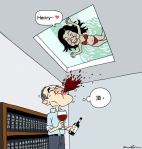 |
| Henry's wine cellar below swimming pool Henry Tang should withdraw from the chief executive race or be ordered to do so. The bosses in Beijing know he has lost public trust. He has used his long-suffering wife twice to take the heat off him. He has no moral authority to lead Hong Kong. |
Beijing’s carefully choreographed opera for the quasi-election process has collapsed so fast and so critically close to the end-game. There is barely ten days left for the HK-Macau Affairs Office to quick-fix this crisis. The puppeteer has to pull the strings for the DAB, the HK Federation of Trade Unions and other allies to cast their nominations and votes to a revised script. But for which candidate?
The business lobby within the 1,200 electoral college is stymied. Tycoons do not want CY Leung but voting for the third candidate Albert Ho of the Democratic Party is a waste as Beijing won’t even allow leading Democrats travel access into the mainland!
Beijing’s mantra of “preserving the stability and prosperity of Hong Kong” - which they adopted as the narrative from the British administration, is lacking a stage prop. The CE quasi-election is in real danger of degenerating into pure farce.
Regina Ip’s golden moment? Regina Ip, infamous for trying to ram through the flawed Article 23 Security Bill in 2003, as secretary for security, now leads the New People’s Party. She was elected to the Legislative Council in 2008. She declared her interest to run for chief executive before but withdrew when she could not secure the minimal 150 nominations.
Regina hopes the business lobby may swing behind her as the de-facto alternative to CY Leung. Despite a supportive response from her party caucus last night, she is still dithering, unsure if at this late stage she can secure 150 nominations or have time to pitch for votes from the Election Committee. She will need momentum which only a nod from Beijing can energize. She is viewed a ‘neutral’ candidate not beholden either to the business lobby or the leftists. She is well regarded by civil servants who fear the whip of CY Leung.
Regina Ip at the start of the CE race described both Henry Tang and CY Leung as lacking the necessary "leadership qualities, competence and stamina" for the top job. She had received feelers from both camps for the position of chief secretary in the civil service. She declared she would not serve in an administration of either candidate.
Why not CY Leung?
The government’s leak of the 10-year old conflict of interest issue on the West Kowloon Arts Centre design selection apart, CY Leung has conducted a dignified campaign on his own. No one in the HK administration has explained why it was necessary to exhume this 10-year old case at this time. It could have just ignored the East Week report instead of responding to it in the middle of the CE race.
CY is neither a stooge of the business lobby nor leftwing ideologues, although his strident anti-British sentiment is well known. Beijing has long identified him as a patriot in HK. He was given very senior responsibility in drafting the Basic Law and as convenor of the post-1997 Exco since.
He knows how the HK government operates and why it has been dysfunctional the last 14 years. He understands the festering issues left unresolved and sympathizes with the bottom rung of society. He knows the tricks of the property lobby only too well and they fear him for that. He has been consistently preferred by a wide margin on all the public polls.
Perhaps it is in CY’s consistently independent streak that Beijing has misgivings. The minders at the HK-Macau Affairs Office and the Central Government Liaison Office are relaxed about the vacuity of candidate Tang. He just coasts along and is happy to follow any path shown. Candidate CY Leung has a mind of his own. He thinks. Such men are dangerous?
ENDS
Saturday, 11 February 2012
Who's Afraid of CY Leung?
 |
| CY is not Regina Ip's favourite person |
A grim-faced CY Leung stares out of the front page of the South China Morning Post on Friday. The HK government had confirmed his conflict of interest omission on a jury panel selecting designs for an arts centre hub project 10 years ago. The company involved was disqualified when it was discovered that CY Leung was an advisor through his firm DTZ Holdings.
The incident was re-surfaced by East Week magazine of the Sing Tao News media group. Charles Ho, chairman of the group had gone on TV recently to question CY Leung's credentials for the CE position after CY accused the newspaper of conducting a smear campaign against him. CY Leung was a board member of the Sing Tao News but resigned after the falling out.
Was CE race slipping away from Henry Tang? It looked like a shoo-in for Tang when Hong Kong's tycoons closed ranks to declare support for his 2012 chief executive bid. The selection by the 1,200 Election Commission is due on 25 March. The third CE of Hong Kong will take office 1st July 2012 when incumbent Donald Tsang's second term expires.
 |
| Henry just doesn't convince |
Despite this formidable line-up of oligarchs, candidate Tang has been trailing badly in public opinion polls. The 16-19 January poll by Dr Robert Chung of HKU on a sample of 1,022 respondents, recorded 29.7% in favour of Henry Tang, 42.9% for CY Leung and 9.1% for Albert Ho, chairman of the Democratic Party. That is a gap of 13.2% in favour of CY Leung between the two front runners. It has been a similar story on other polls too.
Can CY get 150 nominations to contest?
Despite his lead in the opinion polls, CY Leung has only about 50 of his pledged candidates in the Election Committee. How he is going to secure the requisite 150 nominations is a moot point. Both Henry Tang and the Democratic camp have in excess of 200 pledged candidates each.
The nomination window opens on Valentine's Day 14 Feb and closes on 29 Feb. Tang has avoided a public debate with the other contenders so far. He says he will wait for the official nominations to be tabled before that.
Beijing has not indicated its preference between the two 'approved' candidates. That keeps the party faithful in limbo and anxious. They do not want to jump the gun. They are trained to wait for the whisper. CY is widely regarded the preferred choice among hardcore leftists in Hong Kong. They are very comfortable with him.
The DAB (Democratic Alliance for the Betterment and Progress of Hong Kong) is the largest pro-Beijing party in the Legislative Council and has 147 seats on the 1,200 Election Committee which will select the chief executive. Party chairman Tam Yiu-chung has hinted the party may leave the vote to individual choice as there is no internal consensus to block-vote for either candidate and no pressure from Beijing to do so.
One intriguing option for CY Leung is to court the Democratic camp to shift their 'surplus' nominations to enable him to meet the 150 threshold. There are hints that feelers have been put out to that end. This poses Machiavellian opportunity and ideological conflict for both the Democratic camp and CY.
China defines CE criteria
Director Wang Guangya who heads the Hong Kong-Macau Affairs Office, reports directly to the State Council, China's cabinet. On a visit to Hong Kong in June 2011 to address the Hong Kong Federation of Trade Unions (HKFTU) Wang listed three criteria for the future chief executive: demonstrated love of China and Hong Kong, competence in governance and "a high degree of acceptance among the general public, who should feel that the person elected is not bad".
That has given added symbolic significance to the public polling activity of the Hong Kong and Baptist Universities. Independent polling and disclosure of public views on government does not sit comfortably with the Communist Party. Even consumer marketing surveys in China have to obtain special permits and be approved by the authorities.
So director Wang's listing of popularity and respect as a criteria for the HKSAR chief executive is very progressive thinking for the most important job in Hong Kong - whose 7 million residents are excluded from participation.
Addressing a visiting delegation of HKSAR university students in Beijing last year, Wang roundly criticised the timidity of the British-trained administration, stating that they "still don't know how to be a boss and how to be a master". He observed that they are now in charge but unable to take bold initiatives.
That was the clearest indication yet that the PRC is unimpressed by the HKSAR’s first chief executive Tung Chee-hwa and incumbent Donald Tsang, who between them wasted 14 years through lack of effective leadership on an array of issues like public housing, air pollution, social safety net for the poorest and relief for a middle class squeezed by inflation and runaway property prices.
But the trio now standing for CE do not seem to be right either. Candidate Tang looks weak and ineffectual. Candidate CY Leung scares tycoons and ordinary folk alike. Candidate Albert Ho is unacceptable to Beijing.
Despite running record budget surpluses, the administration seems bereft of problem-solving ideas or the will to shunt the property cartel aside. The collusion between the construction lobby and the administration has created questionable infrastructure schemes to pour more concrete on a third runway, reclaim land from the sea and build long bridges and railway connections to the mainland.
The claimed job-creation effects of these schemes has little relevance for Hong Kong residents. It will only mean more mainland and Third World labour being shipped in. It will certainly enrich the local construction industry and related professional firms - all of whom have well entrenched networks within the administration.
Vision, leadership and a genuine connect with society is absent and HK citizens are fed up. The crying needs of society seem not to excite urgent focus or action. The dramatic and sudden HK$6,000 handout to every HK resident in the 2011 budget was the high-water-mark of societal thinking in the Donald Tsang administration. It was a gesture copied from the Macau SAR where casino income was cascading into government coffers.
Director Wang is right on this count.
Pollsters under fire
Both universities and the professors who supervise the surveys have come under attack from the leftist Chinese language newspapers Ta Kung Pau, Wen Wei Pau and the English language China Daily.
Dr Zhao Xinshu of Baptist University released his survey showing Henry Tang reducing CY Leung's lead before the full sampling data was processed. It was premature and academically unsound. Dr Zhao quit on 6 Feb, the day the Baptist University released its 12 page investigation report.
The head of Baptist University has resisted further investigations, warning of unleashing “white terror” a loaded reference to the worst excesses of the Cultural Revolution. There is serious concern about academic freedoms eroding in HK.
Hao Tiechuan, director of publicity, culture and sport at the Central Government Liaison Office in Hong Kong (the former Xinhua News Agency renamed in 2000) took particular objection to one of Hong Kong University's recent surveys which noted that more residents identified themselves primarily as HK citizens first rather than as citizens of China.
Dr Chung who heads the Public Opinion Poll (POP) at HKU has been tracking this particular sentiment for 12 years. He says respondents' identification preferences go up and down, influenced by positive events like the Beijing Olympics and declines on criticism from Chinese officials and China's abuse of dissidents at home.
Dr Robert Chung stands his ground against "Cultural Revolution-style" criticism. He has invited the left wing newspapers and other critics to a dialogue to answer any question on his survey methodology. Chung says so far no one from the Liaison Office, the mainland press or the university authorities have contacted him.
Meanwhile, Chung has devised a 'civic referendum' to enable members of the public to indicate their preferred CE candidate on 23 March, two days before the 25 March Election Committee voting. He says eligible voters will be able to access a polling station and participate online and through mobile phones. He would not seek funding from the university, the HK government or political parties. He hopes the HK$500,000 needed for this project will come from public donations.
ENDS
Subscribe to:
Posts (Atom)